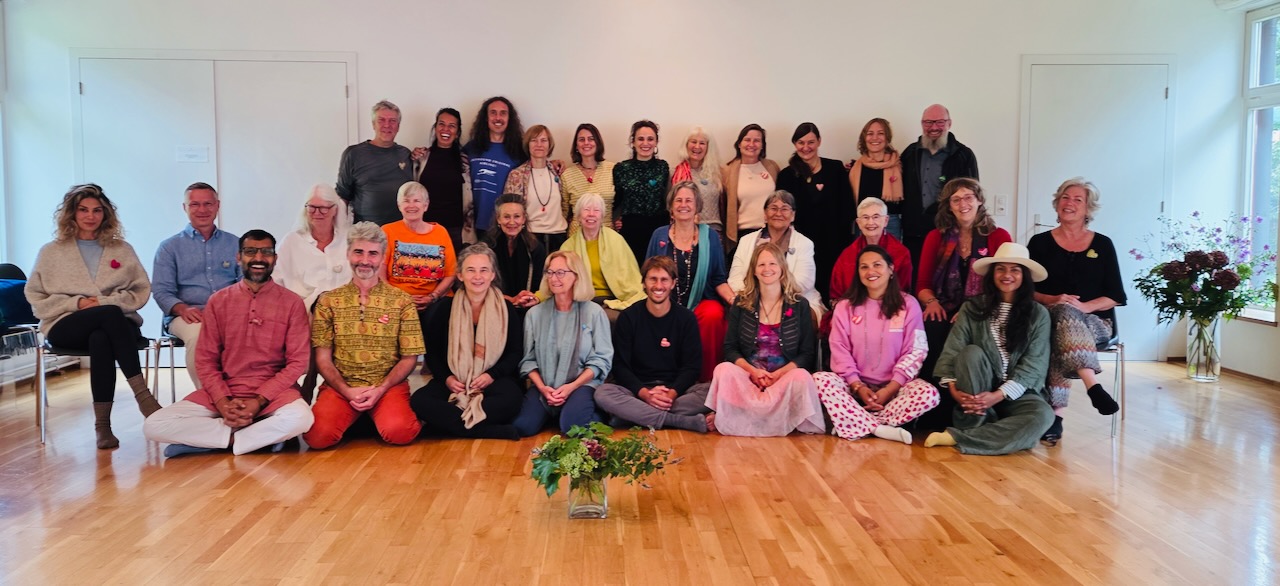
In late August 2025, thirty‑three people from different countries, disciplines and spiritual lineages gathered at Villa Unspunnen near Interlaken, Switzerland, for the first Spirit of Oneness Retreat. Embedded in the dramatic landscape between the Eiger, Mönch and Jungfrau, this circle met not to discuss Oneness as an idea, but to explore it as a lived reality through silence, dialogue, embodied practice and multidimensional ritual. Over several days, a “golden thread” became visible – a felt sense of unity, love and deep coherence weaving through diverse experiences.
The Spirit of Oneness retreat offers a rare, embodied glimpse of what becomes possible when leadership, power, not‑knowing and unity are coherently aligned. It created conditions in which Oneness could be directly experienced as a living field. This review intends to trace the conditions that allowed such a field to emerge and the insights it offers for future work with leadership and transformation.
Leadership in service of the field
Leadership at Spirit of Oneness was clear yet remarkably light and joyful. Three co‑facilitators held the space “with love, light and laughter”, each bringing distinct gifts – connection to place and multidimensionality, planetary and cosmic perspective, and moderation of meaning and participation. Rather than pushing a pre‑set program, they continually tuned into what wanted to emerge, explicitly inviting the subtle realms, nature, ancestral and even star lineages into the gathering - and creating space for everyone to join in this.
Power - a word that hardly fits the context - was thus exercised as service: grounded in deep listening rather than control, expressed as invitation, and shared with the circle instead of concentrated in a single authority.
The underlying design – Instigation, Inner‑Tuition, Integration – created a strong, simple architecture that held the group without constraining it. Within this frame, participants were invited to become “soul‑models”, co‑creating the field through their presence and contribution rather than consuming a sequence of sessions.
Not‑knowing as shared practice
A defining quality of the retreat was the way not‑knowing was honoured. Rather than being treated as a deficit to be fixed, the “field of unknowing” was named as a sacred space.
The process deliberately opened room for intuition and inner tuition, used poetry, movement, ritual and constellation work to access non‑linear intelligences, and invited trust in and surrender to what cannot be planned or captured conceptually.
In this way, not‑knowing became a collective practice: participants could rest together in stillness, listening for and engaging with what wanted to emerge next. Uncertainty was not a gap in leadership, but a consciously held threshold between what had been and what was coming into being.
Oneness as lived reality
The Spirit of Oneness Retreat was rooted in the conviction that unity is not merely an ideal but a fundamental reality that can be experienced and enacted.
This was cultivated on several levels. The retreat was framed within a cosmic and planetary context: Gaia, cosmic intelligences, ancestors, future generations and subtle realms were explicitly acknowledged as active participants in the field, expanding the sense of “we” beyond the human circle. Collective field work invited the group to explore what the “Knowing Field” wanted them to see about what is emerging. Through embodied practices like Qi Gong, dance, nature immersion, gong ceremony, meditation, spontaneous dancing and shared laughter, nervous systems softened and unity was anchored in the body; participants spoke of renewed trust in life, a felt sense of belonging, courage to live from the heart and a commitment to serve life where they are.
A central metaphor – the golden thread – captured the insight that “we are already woven, remembering how to move together.” Oneness was thus experienced as something to be acknowledged, to relax into and to be nurtured by.
Love as an organising force of life itself
The golden thread also lent itself as a symbol pointing to the power of Love - Love as an organising force of life itself. By practicing Love-in-Action we as human beings co-create with the larger planetary and cosmic forces.
Deep coherence
What emerged over the days was not conceptual agreement but coherence. The triple‑loop design invited action, reflection and re‑configuration of being, allowing insights to ripple through individual, relational and subtle dimensions.
In my view, the most important elements supporting coherence included: a clearly held intention to serve the good of the whole and the evolutionary potential of humanity, a process architecture that balanced form and freedom, continuous reflection and adaptation of the design, deep respect for the not-knowing, the willingness of all to surrender to the flow, and a rhythm of silence, expression and integration that kept returning the group to shared ground.
Because of this, differences in background, language and spiritual framing did not fragment the field; they enriched it. The retreat became a “living field of love‑in‑action”, in which diversity could be held within an underlying sense of oneness.
A felt example for future work
Spirit of Oneness offers a felt example of conditions that allow collective processes to become deeply generative:
Leadership that is anchored in inner alignment and humble service, rather than in control or charisma.
Power understood as something that flows through a coherent field, rather than as something individuals hold over one another.
Love as an organising force of life itself.
Not‑knowing embraced as a shared threshold, held by practices of listening and stillness.
Oneness cultivated as an embodied experience, through which joy, courage, tenderness and clarity naturally arise.
Coherence tended as an ongoing practice, a lived experience that hopefully carries on - in ways seen and unseen - in the individual lives of the participants, as well as in the subtle realms and the collective.
In this sense, the retreat can be seen as a prototype of another way of being together: a way in which the deeper intelligence of life itself is trusted to move through the many, as one. Leadership thus becomes an expression of love‑in‑action.